I created a free account for Codepen to provide a demo with my blog post about ‘Creating a custom toggle in TailwindCSS’ but it took me a little while to figure out how to use Tailwindcss with codepen. So, this is what I did to get it working.
Add the Play CDN
Looking at the get started guide in Tailwindcss documentation, it states:
Use the Play CDN to try Tailwind right in the browser without any build step. The Play CDN is designed for development purposes only, and is not intended for production.
<meta charset="UTF-8" />
<meta name="viewport" content="width=device-width, initial-scale=1.0" />
<script src="https://cdn.jsdelivr.net/npm/@tailwindcss/browser@4"></script>
First I copied and pasted the section from the <head> tags in the Tailwind into the HTML section of Codepen, but you shouldn’t do this.
I got a warning in Codepen saying the HTML section is only for content inside the body tags. So this needed to go somewhere else.
Pen settings
Instead of putting the above in the HTML section, you need to open the Pen settings, by clicking on the Settings button with the big cog.
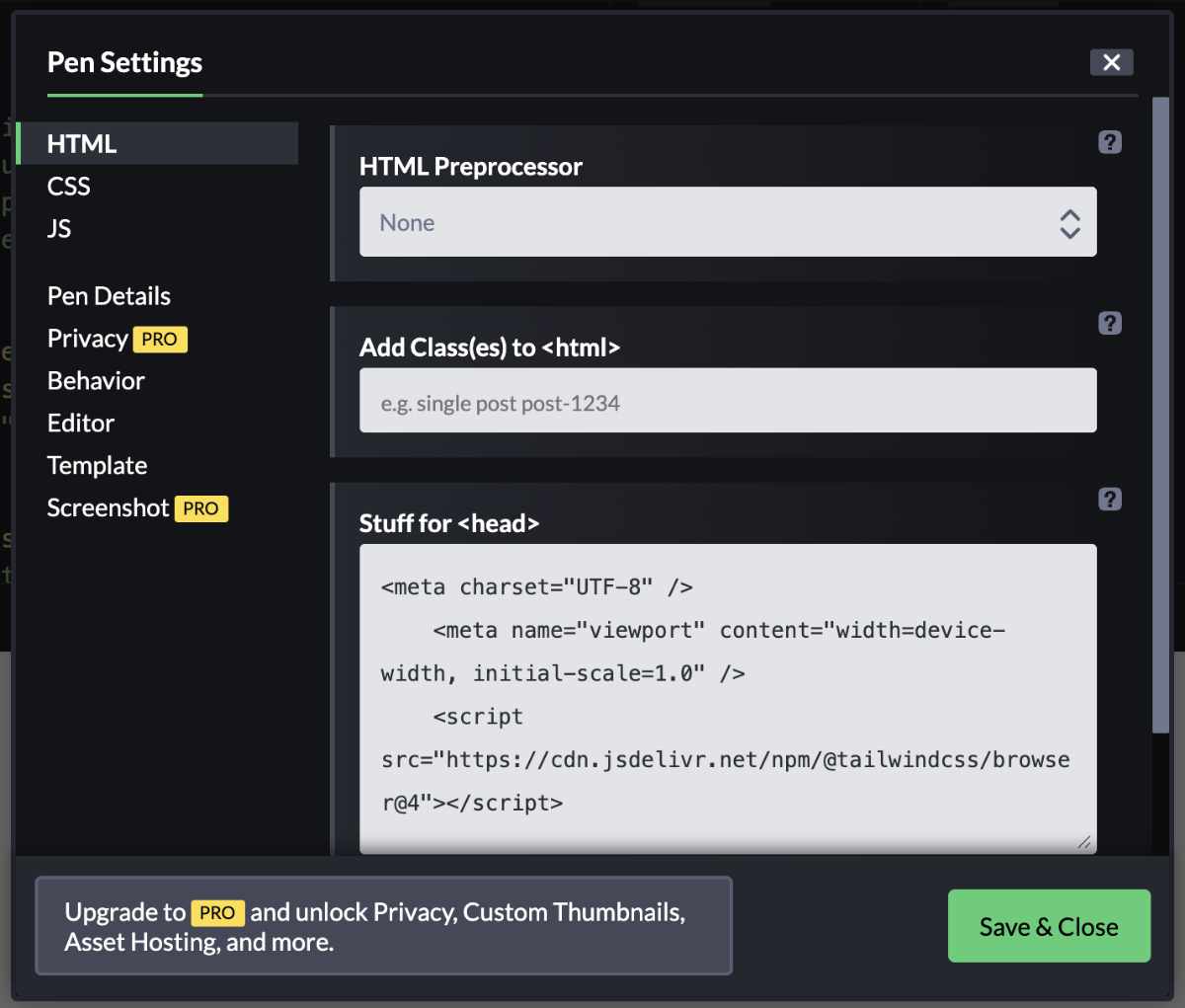
Once in the settings, click on the HTML section on the left, then find the Stuff for <head> section and paste it in there.
Then click Save and close.
Away you go
Now you can start writing your HTML in the HTML section and adding the Tailwindcss utility classes. The page will refresh and display your styled content.
Customising the theme
As the Tailwindcss documentation states, you can also customise your theme by adding a style tag with the type="text/tailwindcss" attribute.
This seems to work in either the main HTML section or within the Stuff for <head> section in the settings.
<style type="text/tailwindcss">
  @theme {
    --color-clifford: #da373d;
  }
</style>
<p class="text-clifford">Test</p>
Photo by Sergei Gussev on StockSnap